

You can make money with YouTube through ads, for which your channel has to be in the YouTube Partner Program, and through sponsorships, affiliate links, memberships and your own products. YouTube doesn’t pay per view: you get a share of the ad revenue, and how much that comes to depends above all on your topic, where your viewers live and the type of video. Below you’ll find the requirements, how the calculation works, what creators report per 1,000 views and the other ways to earn.
The short answer
- You only earn from ads once your channel is in the YouTube Partner Program.
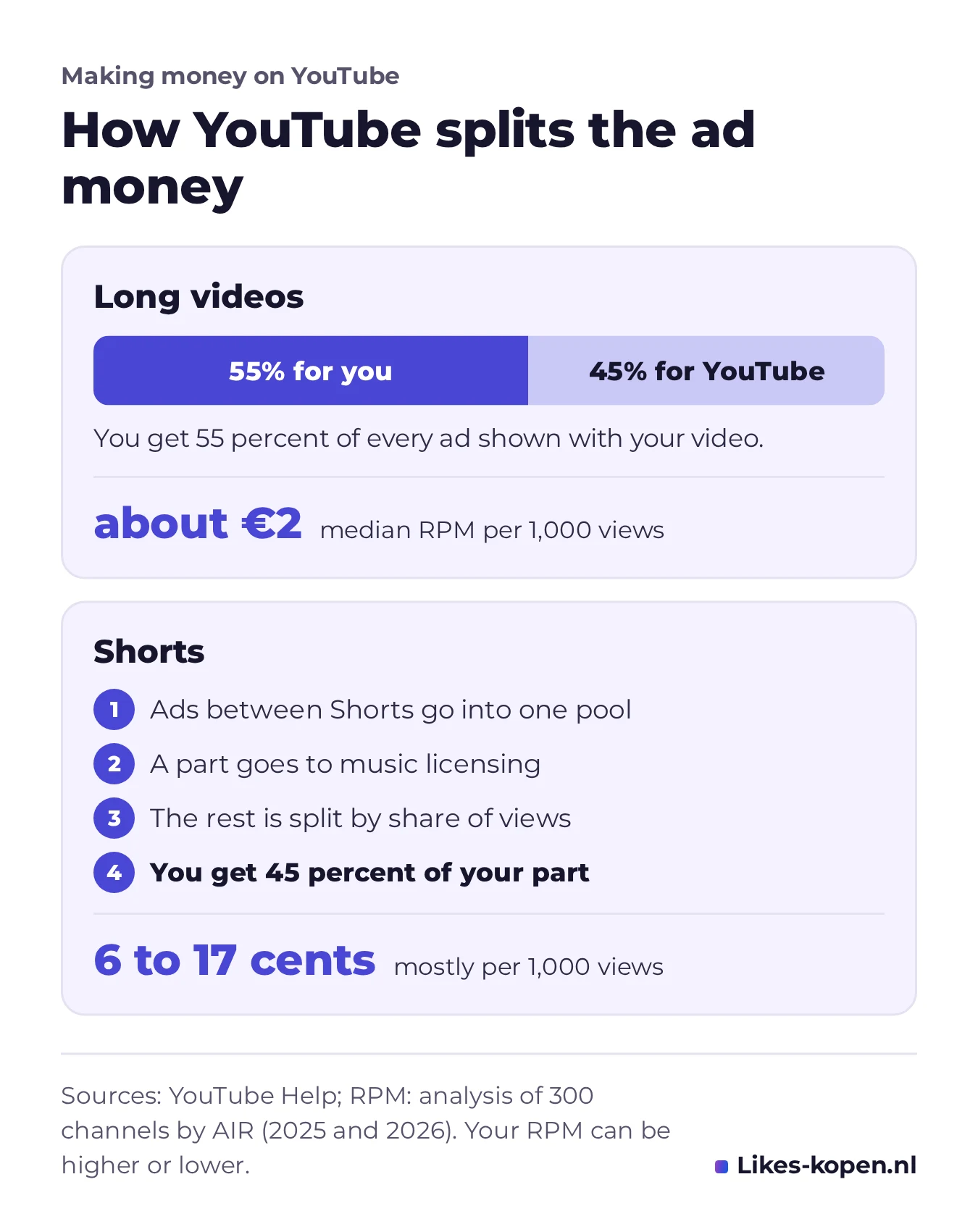
- On long videos you get 55 percent of the ad revenue, on Shorts 45 percent of the part allocated to creators.
- What you keep per 1,000 views varies enormously: often a few euros on long videos, often a few cents on Shorts.
- For many creators, other sources matter at least as much: sponsorships, affiliate links, memberships and their own products.
When can you make money with YouTube?
The rules for the Partner Program have changed often over the years. At the time of writing, these are the requirements:
- For ad revenue: 1,000 subscribers, plus 4,000 valid public watch hours in the last 12 months or 10 million valid public Shorts views in the last 90 days. YouTube has announced that from 1 February 2027 new applicants will need 8,000 watch hours in a year or 20 million Shorts views in 90 days.
- For some features, such as channel memberships, Super Chat and Super Thanks, a lower threshold applies in a growing number of countries: 500 subscribers, 3 public uploads in the last 90 days, and 3,000 watch hours in 12 months or 3 million Shorts views in 90 days.
- On top of that, you live in a country where the programme is available, your channel has no active Community Guidelines strikes, you use 2-Step Verification on your Google account, and you link an AdSense account.
After you apply, YouTube reviews your channel by hand, which usually takes about a month. Even after that, YouTube decides per video whether ads can run on it. You can see the requirements that apply to your channel in YouTube Studio under Earn.
Which videos earn nothing?
YouTube only pays for original videos. Videos made in bulk with little input of your own, such as the same template over and over or read-out text over stock footage, are not eligible. Since July 2025, YouTube has called this “inauthentic content”. So a faceless channel (sometimes called a cash cow channel) can earn money just fine, as long as you put your own script, research or editing into it. Videos made for kids earn less, because they don’t get personalised ads.
How much does YouTube pay per 1,000 views?
Once your channel is in the programme, you’ll see two figures in YouTube Studio:
- CPM: what advertisers pay per 1,000 times an ad is shown, before YouTube’s share.
- RPM: what you keep per 1,000 views, after YouTube’s share and including views where no ad was shown. This is the figure that counts.
What creators say about their own RPM varies widely. For long videos with mainly Dutch viewers, you often hear amounts of roughly €1 to €5 per 1,000 views, and sometimes considerably more for topics like money, insurance and software, or with viewers in countries where advertisers pay more, such as the United States. An analysis of 300 channels by AIR Media-Tech (2025 and 2026) found a median RPM of about €2 for long videos, and mostly 6 to 17 cents per 1,000 views for Shorts. These amounts don’t come from us or from YouTube: your RPM can be far above or below them. The month matters too: in the same analysis, RPM in January was about a third lower than in November, when advertisers pay more ahead of the holidays.
So per view it is a fraction of a cent. At an RPM of €2, one view is worth €0.002 on average.
Worked example
| Views (long videos) | At RPM €1 | At RPM €3 | At RPM €5 |
|---|---|---|---|
| 10,000 | €10 | €30 | €50 |
| 100,000 | €100 | €300 | €500 |
| 1,000,000 | €1,000 | €3,000 | €5,000 |
This is only an example calculation, not a promise: your RPM differs per video and per month. Want to work it out for your own channel, with your viewers’ country and your topic? Use our free calculator.
Free toolYouTube money calculatorEstimate what you earn from YouTube ads, per month and per 1,000 views, for long videos and Shorts, by country and topic.Open the calculatorWhy one YouTuber earns more than another
- Topic: advertisers pay more for viewers who are about to buy something expensive, as in finance, software or cars, than for gaming or funny clips, for example.
- Your viewers’ country: viewers from countries where advertisers pay a lot, such as the United States, bring in more. Videos in a smaller language, such as Dutch, also have a smaller audience than videos in English.
- Length: in videos of 8 minutes or longer you can also show ads partway through. Don’t make a video longer than it needs to be for that: if viewers drop off, you lose more than you gain.
- Time of year: advertisers pay more in the months before the holidays, and it often drops again in January.
- Type of video: Shorts earn much less per view than long videos.
How much do you earn with YouTube Shorts?
Since 1 February 2023, YouTube has shared ad revenue with Shorts creators, but it works differently from long videos. The revenue from ads between Shorts goes into one pool, part of it goes to music licensing, and the rest is divided according to each creator’s share of the views. You get 45 percent of your share. Because that pool is spread over a huge number of views, the revenue per view is low. Shorts are mainly useful for drawing new viewers to your channel and your long videos. How to get more of those is covered in more YouTube views.
Note: YouTube has announced that from 1 February 2027, only channels with at least 10 million qualified Shorts views in the last 90 days will share in the ad and subscription revenue from Shorts. Below that, Shorts will no longer earn you ad money, while long videos still will.
Other ways to make money with YouTube
- Channel memberships: viewers pay monthly for extras, such as badges or members-only videos. At the time of writing you get 70 percent, after taxes and any app store fees.
- Super Chat, Super Stickers and Super Thanks: viewers pay to highlight their message in a livestream or under a video. Here too you get 70 percent.
- YouTube Premium: when Premium members watch your videos, you get part of their subscription fee, in proportion to their watch time.
- Sponsorships: a brand pays you to show or mention a product, and you agree the amount yourself. Tick the box saying the video contains paid promotion, so viewers can see it is advertising.
- Affiliate links: you share a link to a product and get a percentage when someone buys through your link. Many online shops have a partner programme for this.
- Your own products or services: merchandise, a course, coaching or your own business. For small channels with a specific topic, this is often a better source of income than ads.
Ad revenue is paid out through AdSense. Google pays once your balance reaches the payment threshold, at the time of writing €70 for accounts in euros. YouTube income is taxable, so declare it in the country where you live (in the Netherlands, to the Belastingdienst).
Do bought subscribers or views help you make money?
Not directly, and we would rather be honest about that:
- Our standard subscribers and views come from real-looking, high-quality profiles, not from active viewers. They don’t watch ads, so they don’t earn you anything.
- For the Partner Program, YouTube only counts valid watch hours and reviews your channel by hand. Artificial activity can be a reason to reject your application.
- What it does do: with more subscribers or views, a new channel or a new video looks more trustworthy to its first visitors.
- YouTube doesn’t allow buying in its terms and can remove part of it again. Whatever drops off within 90 days, we refill free of charge.
Still want to give a new channel that push? Take a look at our YouTube subscribers. Using your channel for a business or as an influencer? Then read whether buying likes is legal first.
Frequently asked questions about making money with YouTube
How much does YouTube pay per view?
A fraction of a cent. YouTube doesn’t pay per view, but shares ad revenue. At an RPM of €2, one view earns €0.002 on average, and with Shorts usually much less.
How much does YouTube pay per 1,000 views?
There is no fixed amount. What you keep per 1,000 views (your RPM) depends on your topic, your viewers and the type of video. Creators often mention a few euros for long videos and a few cents for Shorts, but it differs enormously per channel. You can see your own RPM in YouTube Studio.
How much do you earn with 1 million views on YouTube?
With an RPM of €1 to €5, that is €1,000 to €5,000 for long videos. A million Shorts views usually brings in only a fraction of that. It remains an example calculation: your RPM can be higher or lower.
Can you make money with a faceless YouTube channel?
Yes, if your videos are original: your own script, research, voice or editing. Channels that mass-produce the same kind of video with little input of their own are not eligible for revenue under YouTube’s rules.
How long does it take to start making money on YouTube?
That depends on how quickly you reach the Partner Program thresholds, and for most channels it is a matter of months rather than weeks. How to set up a channel and get subscribers is covered in free YouTube likes and subscribers.


Need help with your order?
Mazie and Jane from our customer service team help you through the live chat (Monday to Friday 9:00 to 20:00, Saturday 9:00 to 16:00) or by email at support@likes-kopen.nl. We usually reply within an hour, in Dutch, English, German or French. Meet our team.

